Free Ebook The Art of Thinking Clearly, by Rolf Dobelli
Below, we have various publication The Art Of Thinking Clearly, By Rolf Dobelli and collections to read. We also serve variant kinds as well as sort of the books to search. The fun book, fiction, history, unique, science, and various other kinds of publications are readily available right here. As this The Art Of Thinking Clearly, By Rolf Dobelli, it turneds into one of the recommended publication The Art Of Thinking Clearly, By Rolf Dobelli collections that we have. This is why you remain in the appropriate site to view the outstanding publications to own.
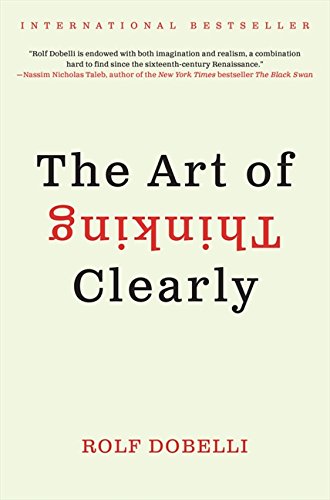
The Art of Thinking Clearly, by Rolf Dobelli

Free Ebook The Art of Thinking Clearly, by Rolf Dobelli
Some individuals might be chuckling when considering you reading The Art Of Thinking Clearly, By Rolf Dobelli in your leisure. Some could be admired of you. And also some might really want be like you which have reading leisure activity. What concerning your very own feel? Have you really felt right? Reading The Art Of Thinking Clearly, By Rolf Dobelli is a requirement and a hobby at once. This problem is the on that will certainly make you feel that you need to check out. If you recognize are looking for the book entitled The Art Of Thinking Clearly, By Rolf Dobelli as the option of reading, you could find right here.
This publication The Art Of Thinking Clearly, By Rolf Dobelli deals you better of life that could develop the quality of the life more vibrant. This The Art Of Thinking Clearly, By Rolf Dobelli is exactly what individuals currently require. You are here and you might be specific as well as sure to get this book The Art Of Thinking Clearly, By Rolf Dobelli Never ever doubt to obtain it even this is merely a publication. You could get this publication The Art Of Thinking Clearly, By Rolf Dobelli as one of your collections. But, not the compilation to present in your shelfs. This is a valuable publication to be reading compilation.
How is to make certain that this The Art Of Thinking Clearly, By Rolf Dobelli will not presented in your bookshelves? This is a soft file book The Art Of Thinking Clearly, By Rolf Dobelli, so you could download and install The Art Of Thinking Clearly, By Rolf Dobelli by buying to obtain the soft data. It will alleviate you to read it whenever you need. When you really feel lazy to relocate the printed book from the home of workplace to some place, this soft documents will certainly alleviate you not to do that. Due to the fact that you could only save the data in your computer hardware and gizmo. So, it enables you review it all over you have readiness to review The Art Of Thinking Clearly, By Rolf Dobelli
Well, when else will certainly you locate this possibility to get this publication The Art Of Thinking Clearly, By Rolf Dobelli soft documents? This is your good opportunity to be here as well as get this excellent publication The Art Of Thinking Clearly, By Rolf Dobelli Never leave this book prior to downloading this soft file of The Art Of Thinking Clearly, By Rolf Dobelli in link that we offer. The Art Of Thinking Clearly, By Rolf Dobelli will actually make a large amount to be your friend in your lonesome. It will be the most effective companion to boost your business and pastime.
The Art of Thinking Clearly by world-class thinker and entrepreneur Rolf Dobelli is an eye-opening look at human psychology and reasoning — essential reading for anyone who wants to avoid “cognitive errors” and make better choices in all aspects of their lives.
Have you ever: Invested time in something that, with hindsight, just wasn’t worth it? Or continued doing something you knew was bad for you? These are examples of cognitive biases, simple errors we all make in our day-to-day thinking. But by knowing what they are and how to spot them, we can avoid them and make better decisions.
Simple, clear, and always surprising, this indispensable book will change the way you think and transform your decision-making—work, at home, every day. It reveals, in 99 short chapters, the most common errors of judgment, and how to avoid them.
- Sales Rank: #231557 in Books
- Published on: 2013-05-14
- Released on: 2013-05-14
- Original language: English
- Number of items: 1
- Dimensions: 8.25" h x 1.21" w x 5.50" l, 1.08 pounds
- Binding: Hardcover
- 384 pages
From Booklist
*Starred Review* Why do we stay in bad relationships or stubbornly hold on to failing investments? Dobelli, author and founder of Zurich.Minds, a community of thinkers, explores the natural tendencies we have to think illogically and how we can overcome them. This is not a facile how-to book but a serious examination of the faulty reasoning that leads to repeated mistakes by individuals, businesses, and nations. Among the logical errors Dobelli explores are survivorship bias, or systematic overestimation of the chances for success, and social proof (otherwise known as herd mentality), or feeling that an action or decision is correct because so many others are doing the same thing. Herd mentality is often demonstrated in the stock market, triggering bubbles and panics alike. Dobelli warns against the influence of so-called experts, news anchors, beautiful people, teams of workers, and others, cautioning readers to learn to think clearly for themselves. He offers some 99 common errors, drawing on social science, psychology, economics, and politics for amusing and sobering examples of the failure to think logically. In this fascinating book, Dobelli does not offer a recipe for happiness but a well-considered treatise on avoiding “self-induced unhappiness.” --Vanessa Bush
Review
“A fireworks show of insights into how our minds work. If you want to avoid tripping on cognitive errors, read this book.” (Iris Bohnet, Professor and Academic Dean, Harvard Kennedy School, Director of the Harvard Decision Science Laboratory)
“Dobelli examines our most common decision-making failings with engaging eloquence and describes how to counter them with instructive good sense.” (Robert Cialdini, author of Influence)
“…a serious examination of the faulty reasoning that leads to repeated mistakes by individuals, businesses, and nations…In this fascinating book, Dobelli does not offer a recipe for happiness but a well-considered treatise on avoiding ‘self-induced unhappiness.’” (Booklist (starred review))
“…easy-going prose…what [Dobelli] does is pinpoint exactly the assumptions, bias and illusions that shape our thinking and decision-making processes in both business and personal relationships that can cost us dearly as individuals and as a society.” (Financial Times)
From the Back Cover
Have you ever . . .
- Invested time in something that, in hindsight, just wasn't worth it?
- Paid too much in an eBay auction?
- Continued to do something you knew was bad for you?
- Sold stocks too late, or too early?
- Taken credit for success, but blamed failure on external circumstances?
- Backed the wrong horse?
These are examples of what the author calls cognitive biases, simple errors all of us make in day-to-day thinking. But by knowing what they are and how to identify them, we can avoid them and make better choices: whether in dealing with personal problems or business negotiations, trying to save money or earn profits, or merely working out what we really want in life—and strategizing the best way to get it.
Already an international bestseller, The Art of Thinking Clearly distills cutting-edge research from behavioral economics, psychology, and neuroscience into a clever, practical guide for anyone who's ever wanted to be wiser and make better decisions. A novelist, thinker, and entrepreneur, Rolf Dobelli deftly shows that in order to lead happier, more prosperous lives, we don't need extra cunning, new ideas, shiny gadgets, or more frantic hyperactivity—all we need is less irrationality.
Simple, clear, and always surprising, this indispensable book will change the way you think and transform your decision making—at work, at home, every day. From why you shouldn't accept a free drink to why you should walk out of a movie you don't like, from why it's so hard to predict the future to why you shouldn't watch the news, The Art of Thinking Clearly helps solve the puzzle of human reasoning.
Most helpful customer reviews
2 of 2 people found the following review helpful.
including the highly intelligent, resulting in everyone falling into the same cognitive ...
By Ian Mann
In the 1960s psychologists began to examine scientifically, how people think, decide and take action. The result, explains the author of this book, Rolf Dobelli, was a “theory of irrationality that states: thinking is in itself not pure, but prone to error.” This, they found, was true of all people, including the highly intelligent, resulting in everyone falling into the same cognitive errors.
More interestingly, it appears we all “systematically err in the same direction.” If this is indeed true, it means we all make predictable mistakes. If it is true, and it appears to be, we should be able to fix at least some of them and avoid making these errors in our lives.
Dobelli has gathered 99 errors common to us all. He provides short, amusing and pithy insights into their form and causes. This has not made his life error free, he reports. However, “to make things simple, I have set myself the following rules: in situations where the possible consequences are large, I try to be as reasonable and rational as possible when choosing… In situations where the consequences are small I forget about rational optimisation and let my intuition take over.”
This book is a useful compendium of error. Reading this book will certainly increase one’s awareness of possible errors, which will lead to better decisions. To illustrate, I have chosen five errors of the Dobelli’s 99.
Social Proof
You are roaming the Serengeti some 50,000 years ago, and your hunter-gather companions suddenly break into a desperate run away from some disturbance. What should you do? Mindlessly follow, or consider the possibility that it is a gazelle rather than a predator. Having seen a thoughtful companion become some animal’s lunch you run with the crowd.
“Social proof” is the legacy of this herd instinct that dictates that individuals are behaving correctly when they act the same as other people. Social proof is behind stock market bubbles, as well as stock market stampedes. It is no different in the worlds of fashion, management techniques, and diets.
Social proof informs even simple decision such as selecting a restaurant in an area with which you are unfamiliar. It seems sensible to choose the one that is full over a poorly patronised one.
Novelist W. Somerset Maugham put the error of social proof succinctly: ‘If 50 million people say something foolish, it is still foolish.’
Sunk Cost Fallacy
The film was awful. After an hour, Dobelli whispered to his wife: ‘Come on, let’s go home.’ She replied : ‘No way. We’re not throwing away $ 30.’ The $ 30 is not reason to stay, that would be a thinking error. The money was been spent, and will not be returned. This is an example of the sunk cost error.
So often in business, there is the sense that having invested so much, it would be wrong to stop now. Stopping now, makes the investment seem a mistake. The sunk cost fallacy is most dangerous when we have invested time, money, energy, commitment or love in something.
The need for consistency drives this type of irrational behaviour. Deciding to cancel the project before it is completed is to admit that we had made a mistake.
Sometimes the consequences of this thinking error costs lives as when America extended their involvement in the Vietnam War. Their thinking: ‘We’ve already sacrificed so much for this war; it would be a mistake to give up now.’
Reciprocity
Psychologist Robert Cialdini has studied the phenomenon of reciprocity and concluded that people have discomfort feeling they are indebted to another person.
Dobelli offers this example: “A supplier of screws invites a potential customer to join him at a big sports game. A month later, it’s time to order screws. The desire not to be in debt is so strong that the buyer gives in and places an order with his new friend.”
This phenomenon has a long history. When primitive man’s food supplies were subject to high fluctuations, he needed others to share their food with him. When he killed an animal too large to eat in one day, he would share the meat with others in his group. Doing this would ensure that they share their meat with him when he is short.
When approached in the supermarket, with an offer of a taste of wine, a chunk of cheese or a handful of olives, Dobelli advises to refuse the offer. The error of reciprocity has led many to ending up a pantry full of goods they do not even like.
Contrast Effect
We judge something to be beautiful, expensive or large only if we have something ugly, cheap or small to compare it to.
Experiments indicate that people will walk an extra ten minutes to save $ 10 on food. The same people, however would not walk ten minutes to save $ 10 on a $ 1,000 suit. The whole category of discount business is only viable because of this error, Dobelli claims.
In the investment arena, the error leads people to believe a share is good value because it is 50% below the peak price. The share price is what it is, and comparison is irrelevant. All that matters is whether the share goes up or down in the future.
The contrast effect also plays out in the social arena. If you are dating it is not prudent to double date with your supermodel friend. This makes you appear less attractive than you really are!
Chauffeur Knowledge
According to Charlie Munger, Warren Buffett’s business partner, there are two types of knowledge. “Real knowledge” is what people have when they have invested time and effort to understanding a topic. “Chauffeur knowledge” is the result of learning how to put on a show. Warren Buffett uses the phrase, ‘circle of competence’ to avoid this error. ‘You have to stick within what I call your circle of competence. You have to know what you understand and what you don’t understand. It’s not terribly important how big the circle is. But it is terribly important that you know where the perimeter is.’
It is so easy to not confuse the company spokesperson, the newscaster, and the cliché generator with those who possess true knowledge. You can recognize the difference because the true experts know what they know and what they do not know.
This book is a “must read!” We cannot do enough to protect ourselves from our thinking errors and the author sites 99 such errors. Much of the material in this book can be found scattered elsewhere. The value of this book is that the information is in one place.
Readability Light --+-- Serious
Insights High --+-- Low
Practical High --+-- Low
*Ian Mann of Gateways consults internationally on leadership and strategy and is the author of Strategy that Works.
0 of 0 people found the following review helpful.
Hard to follow and not very memorable.
By Vince
Although some things in this book are interesting I don't feel like the author imparts that information very well or in a memorable manor. I usually have excellent retention for every book I've read but this one I noticed is just kinda thrown out there. He's writing this as short essays rather than a blueprint on analyzing one's thoughts and how to approach things differently. The chapters to me aren't really chapters they're like place holders in an essay. I would often have to go back and re-read things throughout this book because I wouldn't even remember what I was reading. I haven't finished this book because I find it both boring and poorly written. As such its hard for me to focus and even understand what I've been reading in it so naturally I don’t remember it.
0 of 0 people found the following review helpful.
I loved the book for its no-nonsense approach and clarity
By Adelheid Mueller
Each chapter was clear and concise in pointing out fallacies and errors in thinking, that if headed, would prevent a lot of mistakes, heartache and errors. It has just enough examples and explanations to become clear or are reminded of biases, fallacies and lazy thinking. It ought to be mandatory reading. If more people were clear about how they make decisions, adopt opinions or embrace beliefs, the more thoughtful and rational our society would be. I love the book and have given it as gifts several times. I wish he would have his 2nd book translated into English too so I could give it as gifts also.
The Art of Thinking Clearly, by Rolf Dobelli PDF
The Art of Thinking Clearly, by Rolf Dobelli EPub
The Art of Thinking Clearly, by Rolf Dobelli Doc
The Art of Thinking Clearly, by Rolf Dobelli iBooks
The Art of Thinking Clearly, by Rolf Dobelli rtf
The Art of Thinking Clearly, by Rolf Dobelli Mobipocket
The Art of Thinking Clearly, by Rolf Dobelli Kindle

Tidak ada komentar:
Posting Komentar